Lieutenant Commander John Stuart MOULD GC GM
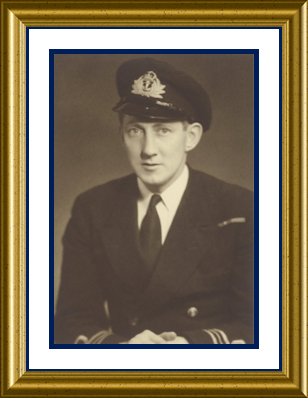 John
Stuart Mould, naval officer and architect, was born on 21
March 1910 at Gosforth, Northumberland, England, son of
Stuart Mill Mould, architect and surveyor, and his wife
Ethel Kate. The family emigrated to Australia when John was
aged 2. Educated at Sydney Grammar School and
subsequently in London, he became an associate of the Royal
Institute of British Architects in 1934. That year he
returned to Sydney and joined his father in private
practice. At the Presbyterian Church, Mosman, on 29
April 1935 he married Phyllis Sarah Palmer; they were to
have one child before being divorced. John
Stuart Mould, naval officer and architect, was born on 21
March 1910 at Gosforth, Northumberland, England, son of
Stuart Mill Mould, architect and surveyor, and his wife
Ethel Kate. The family emigrated to Australia when John was
aged 2. Educated at Sydney Grammar School and
subsequently in London, he became an associate of the Royal
Institute of British Architects in 1934. That year he
returned to Sydney and joined his father in private
practice. At the Presbyterian Church, Mosman, on 29
April 1935 he married Phyllis Sarah Palmer; they were to
have one child before being divorced.
On 14 June 1940 Mould enlisted in the Australian Imperial
Force (AIF). He contracted bronchial pneumonia and,
while recuperating, qualified through the Yachtsmen Scheme
for appointment as sub-Lieutenant, Royal Australian Naval
Volunteer Reserve (RANVR). Discharged from the AIF, he
was mobilised in the RANVR on 14 September and sent to
England for training at HMS King Alfred. With
Hugh
Syme,
H.D. Reid and J.H.H. Kessack, he volunteered for 'special
duties ashore'—service in the Royal Navy's Rendering Mines
Safe (RMS) section. He was provisionally promoted
Lieutenant in December and posted to HMS Vernon.
The RMS section had been established to assist in disarming
the large number of unexploded
 bombs and mines strewn across
Britain by German aircraft. Although most of the work
involved bombs, the RMS's naval personnel were primarily
concerned with 'delousing' German sea mines which had been
dropped on land or washed ashore. Mould performed
'outstanding work on dock clearance operations and those
resulting in the stripping of the early German mine Type G'. bombs and mines strewn across
Britain by German aircraft. Although most of the work
involved bombs, the RMS's naval personnel were primarily
concerned with 'delousing' German sea mines which had been
dropped on land or washed ashore. Mould performed
'outstanding work on dock clearance operations and those
resulting in the stripping of the early German mine Type G'.
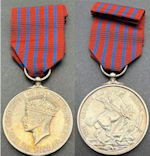
Mould was the first decorated with a King's
Commendation for Brave Conduct in June 1941. This was
followed by a Georga Medal in April 1942, awarded for his...
...successful defusing of a 'George' mine with a
deadly anti-personnel electro-optic detonator.
 Among numerous assignments, Mould recovered, rendered safe
and investigated 'the first German magnetic acoustic unit
and moored magnetic mine'. The successful dismantling
of such weapons allowed British scientists to identify their
triggering mechanisms and thus devise countermeasures.
In addition to the usual hazards of handling explosives,
Mould and his colleagues had to contend with booby traps set
to detonate the mines if attempts were made to disarm and
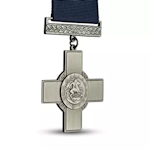
disassemble them. In November 1942 he was awarded the
George Cross - Among numerous assignments, Mould recovered, rendered safe
and investigated 'the first German magnetic acoustic unit
and moored magnetic mine'. The successful dismantling
of such weapons allowed British scientists to identify their
triggering mechanisms and thus devise countermeasures.
In addition to the usual hazards of handling explosives,
Mould and his colleagues had to contend with booby traps set
to detonate the mines if attempts were made to disarm and
disassemble them. In November 1942 he was awarded the
George Cross -
The KING has
been graciously pleased to approve the award of the GEORGE
CROSS for great gallantry and undaunted devotion to duty to:
Lieutenant John Stuart Mould, G.M., R.A.N.V.R.
Promoted acting Lieutenant Commander in January 1943, he
began work with Professor Jack Haldane to develop a
diving-suit with an independent air supply. Later that
year Mould, Lieutenant Leon
Goldsworthy
RANVR, and Lieutenant Commander J.L. Harries, Royal Canadian
Navy, trained groups of men known as 'P' parties in
preparation for the invasion of Western Europe. These
units were to be dispatched to newly captured harbours to
clear them of booby traps, mines and other obstructions.
Declining the opportunity to command one of the parties,
Mould chose instead to continue training men who would serve
in them. Following the German surrender in May 1945,
he was sent to Ceylon (Sri Lanka) and Australia to assess
the requirement for 'P' parties in the Far East and Pacific
theatres. He was designated commander of two of the
parties about the time that World War II ended.
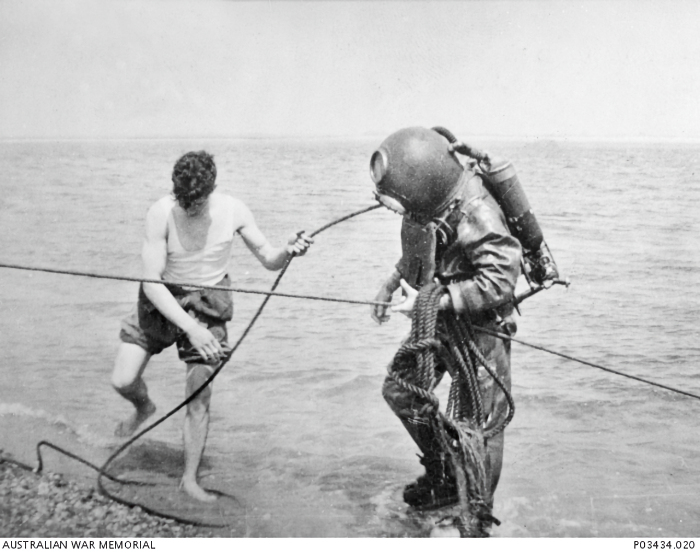
Haling Island. LCDR
John Stuart Mould GC GM,RANVR (right) assisted by an
unidentified
RN rating, prepares to dive on a crashed United States Army
Airforce) bomber aircraft.
The rating is holding a safety rope attached to Moulds' suit
and the latter is holding
a guide line leading to the submerged crash site. The
skein of thicker rope he is holding
was probably for pulling parts of the aircraft and
unexploded ordnance to the shore.
Mould's RANVR appointment terminated on 26 November 1945 in
Britain. He obtained a post as an architect with the
allied military government in Germany and helped with that
country's reconstruction. On 28 May 1947 he married Margaret
Agnes Massey, a 32-year-old divorcee.
He
returned to Australia in 1948 and after working as an
architect with the Department of Public Works, he was
appointed chief architect to the Housing Commission of New
South Wales in 1950. The amount of construction
increased dramatically during his tenure, and he was
responsible for the design of housing estates and shopping
centres. His most conspicuous buildings are the
Greenway apartment blocks in Ennis Road, Milsons Point,
immediately east of the northern approach to Sydney Harbour
Bridge. In 1954, Greenway was the largest apartment
building in the Southern Hemisphere and the first
State-government-owned high-rise social housing in
Australia.
John Stuart Mould GC GM RANVR died of peritonitis on 9 August 1957 in
Royal North Shore Hospital and was cremated. His wife, and
their son and daughter survived him, as did the son of his
first marriage.
Footnote: It is believed the Yachties
were the most decorated cohort of Australian service
personnel in World War II. Their record speaks for
itself:
-
Four George Crosses (GC),
-
Ten George Medals (GM),
-
32 Distinguished Service Crosses
(DSC),
-
38 Mentioned-in-Despatches
(MiD),
-
Three Orders of the British
Empire (OBE),
-
Three Members of the British
Empire (MBE),
-
Two King’s Commendation for
Brave Conduct, and,
-
One Conspicuous Gallantry Medal
(CGM) --- the only one ever to be awarded to an
Australian Navy person.
Sources:
Australian Dictionary of Biography
Australian War Memorial
VC GC Association
Bravo Zulu Vol.1
Compiled by Laurie Pegler |