Commander Karl Erik OOM, OBE, US Legion of Merit, US Bronze Star
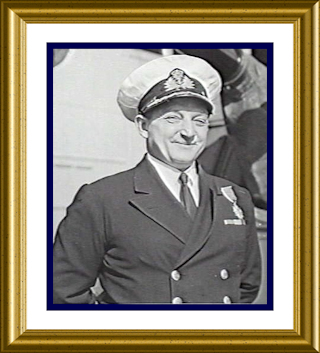 Karl
Erik Oom was born on 27 May 1904 at
Chatswood, Sydney, fourth child of Gustaf Peter Ludwig
August Oom, a draftsman from Sweden, and his English-born
wife May Isabel, née Le Guay. In 1918 Karl entered the Royal
Australian Naval College, Jervis Bay, Federal Capital
Territory, as a cadet Midshipman. Noted for his
individuality and physical fitness, he graduated in 1921.
He trained at sea and completed courses in England before
returning to Australia in March 1926. Karl
Erik Oom was born on 27 May 1904 at
Chatswood, Sydney, fourth child of Gustaf Peter Ludwig
August Oom, a draftsman from Sweden, and his English-born
wife May Isabel, née Le Guay. In 1918 Karl entered the Royal
Australian Naval College, Jervis Bay, Federal Capital
Territory, as a cadet Midshipman. Noted for his
individuality and physical fitness, he graduated in 1921.
He trained at sea and completed courses in England before
returning to Australia in March 1926.
Commencing his career in the RAN's Hydrographic Branch, Oom
joined the survey ship, HMAS Moresby, in May that
year. In July 1927 he was promoted Lieutenant.
He gained respect for his initiative and ability to handle
boats, and for the speed and accuracy of his work.
These qualities led to his selection as a member of Sir
Douglas Mawson's British, Australian and New Zealand
Antarctic Research Expedition (1930-31), on which his
surveys and cartography proved valuable.
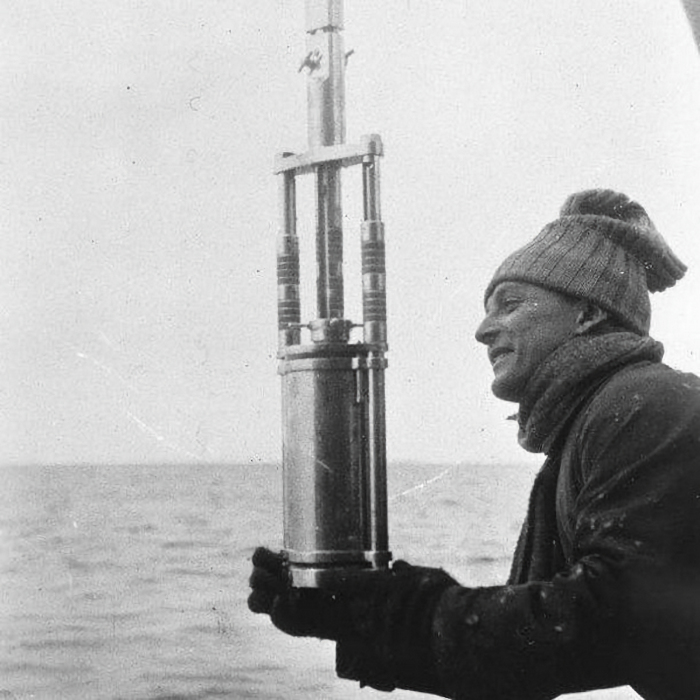
Australian Polar Collection
of Australian naval officer, Karl Erik Oom on board the
‘Discovery’ (1929-31). Here he is pictured operating a
Nansen-Pettersson water bottle –
this device dates back to the late C19th & encloses a
seawater sample from any depth.
On reaching the surface the maximum temperature loss is no
more than 1% of a degree.
In 1932-34 Oom was on loan to the Royal Navy(RN), serving in
HMS Challenger. He spent most of the next five
years either aboard HMAS Moresby or with detached
boat-parties, surveying Torres Strait and the seas off
Queensland, the Northern Territory, Papua and the Mandated
Territory of New Guinea.
Again with the RN in 1939, he was
posted to HMS Franklin. On 17 June that year
at the register office, Hammersmith, London, he married
Evelyn Margaret Stewart Mocatta, née Jeffrey, a 29-year-old
divorcee; they were to remain childless.
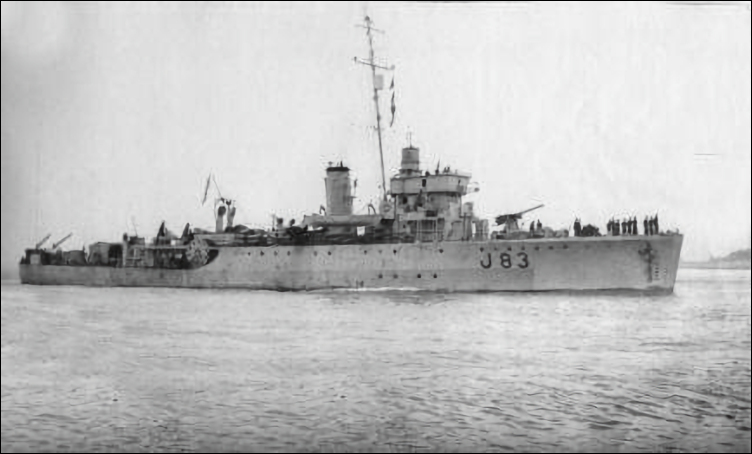
From February 1941 to January 1942, then-Lieutenant
Commander Oom held his first major wartime command aboard
HMS Gleaner (J83), a Halcyon-class vessel serving
the British Royal Navy.
Gleaner was originally designed and launched in
1937 as a specialized civilian hydrographic survey vessel.
At the outbreak of World War II, the Royal Navy immediately
recalled and converted her at Plymouth into a minesweeper
and anti-submarine escort ship. She displaced roughly
830 tons, measured 245 feet long, and was heavily re-armed
with anti-aircraft guns, 4-inch naval guns, and depth charge
throwers to protect convoys.
Oom took command following the ship's famous February 1940
action (where Gleaner successfully hunted and sank the
German submarine U-33 under a previous commander).
Under Oom's leadership, Gleaner was tasked with
grueling anti-submarine patrols and convoy escort
operations. He commanded the vessel through
treacherous, freezing waters across the North Sea and the
eastern Atlantic. His primary responsibility was
defending Allied merchant supply lines from German U-boats
and Luftwaffe air attacks. The experience testing his
leadership in harsh European combat environments prepared
him for his return to Australia, where he was immediately
fast-tracked to command combat hydrographic forces in the
Pacific.
Oom was posted to command HMAS
Whyalla in November 1942. He was ordered to produce
reliable charts for ships involved in the allied offensives
in Papua and New Guinea. While off Cape Nelson, Papua, on 2
January 1943, Whyalla was repeatedly bombed. Spray
from near misses washed survey sheets and the plotting-board
over the ship's side; the work had to be immediately and
painstakingly redone.
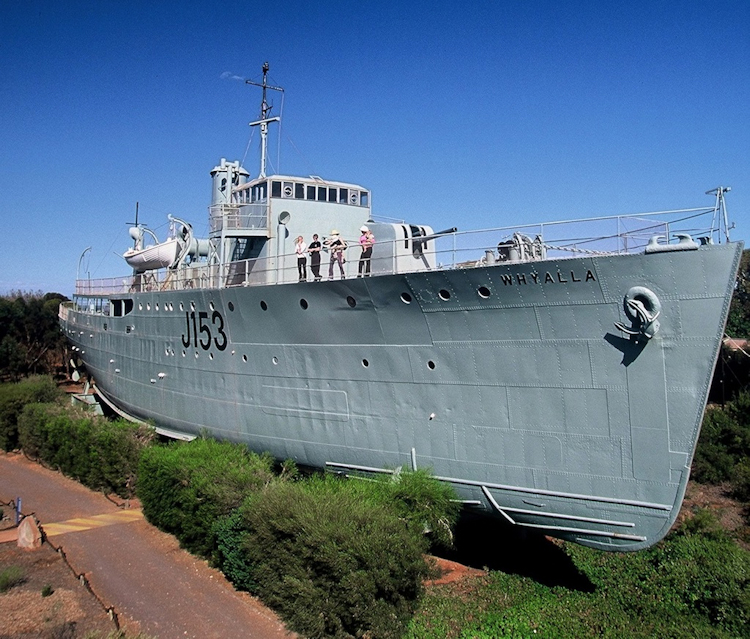
HMAS Whyalla(1) is now the
centrepiece for the Whyalla Maritime Museum which was
officially
opened on 29 October 1988. It is one of only two Bathurst
Class preserved as museum ships,
the other being HMAS Castlemaine in Williamstown, Victoria.
Oom transferred to HMAS Shepparton
in May 1943 and was promoted Commander in June.
Two months later he was appointed officer-in-charge of the
Hydrographic Branch and Commander, Task Group 70.5, which
was responsible for survey operations in the South-West
Pacific Area. He sailed in various ships to find and mark
safe passages for allied landings in New Guinea, the
Philippines and Borneo.
Task Group 70.5 (TG 70.5) was a specialised unit of the
United States Seventh Fleet during World War II, primarily
comprised of Royal Australian Navy (RAN) surveying ships.
Formed in 1943, this force played a crucial role in
hydrographic charting and mine-sweeping during the Allied
advance through the South West Pacific.
Key Aspects of Task Group 70.5:
-
Purpose: The
group conducted detailed surveying of enemy-controlled
or poorly charted waters, marking channels and assisting
minesweeping flotillas in preparation for amphibious
landings.
-
Operational Control:
It was under the overall operational control of the US
7th Fleet Survey Group.
-
Major Operations:
TG 70.5 was involved in numerous critical landings,
including the Admiralty Islands, Morotai, Leyte Gulf,
Lingayen Gulf, Zamboanga, Tarakan, Brunei Bay, and
Balikpapan.
-
Key Vessels:
Ships involved in the group included HMAS Shepparton,
Benalla, Echuca, Warrego, Lachlan, and the flagship HMAS
Moresby.
-
Key Action:
HMAS Shepparton surveyed a channel through the
Japanese-controlled Dampier Strait before the Cape
Gloucester landing, while HMAS Benalla surveyed Seeadler
Harbour during the Admiralty Islands occupation.
Operations and Duties:
-
Advance Surveying:
Conducting hydrographic surveys in forward areas, often
under dangerous conditions while the waters were still
contested.
-
Minesweeping Support:
Routinely forming part of minesweeping flotillas to
clear paths for landing craft.
-
Northern Australian
Waters: Conducting vital survey work in the
Timor and Arafura Seas.
The group remained active until the cessation of
hostilities in 1945.
Oom received several significant Australian, British, and
American honours for his wartime hydrographic and survey
work during World War II. They were:
Antarctic and Academic Honours
-
Polar Medal (Bronze):
Approved by the King in May 1934 with the clasp
"Antarctic 1930–31". It recognised his meticulous
coastal mapping during Sir Douglas Mawson's British,
Australian and New Zealand Antarctic Research Expedition
(BANZARE).
-
Gill Memorial Award:
Awarded in 1945 by the Royal Geographical Society of
London. This distinguished honour recognised his
exceptional achievements in hydrographic surveying and
dangerous marine cartography under wartime constraints.
World War II Military Decorations
-
Officer of the Order of the British Empire (OBE):
Awarded in 1945 within the Military Division. It
honoured his leadership as the Officer-in-Charge of the
Royal Australian Navy (RAN) Hydrographic Branch and his
success in navigating treacherous, unmapped waters for
critical Allied offensives.
-
United States Legion of Merit (Degree
of Legionnaire):
Conferred by the United States government in 1945. Oom
received this for his leadership of Task Group 70.5 within
the U.S. Seventh Fleet, where he discovered and marked safe
passages for pivotal amphibious Allied landings across New
Guinea, Borneo, and the Philippines.
-
United States Bronze Star Medal:
Awarded in 1947 specifically for his extreme bravery and
coolness under pressure in March 1945. Oom
successfully conducted a vital frontline naval survey off
Zamboanga, Philippines, while under direct enemy fire.
Collectively, these honours show that Oom was regarded as
one of Australia’s leading wartime hydrographers, with
contributions valued at both military and scientific levels.
After the war, Oom helped to formulate a new policy by which
the Naval Board - through the senior officer, Hydrographic
Service - became the charting authority for waters around
Australia and the Territory of Papua-New Guinea. From May
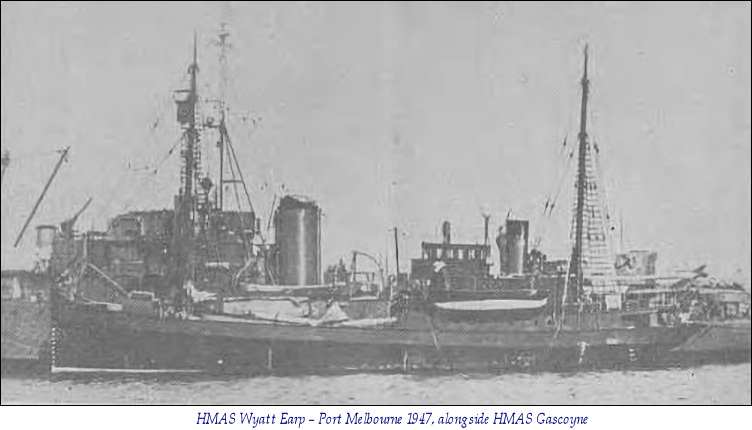
1946 he commanded HMAS Warrego. In November 1947 he
was appointed to command HMAS Wyatt Earp and to
take charge of Antarctic surveys.
From April 1948 Oom again headed the Hydrographic Branch. He
was passed over for promotion to Captain in 1951 and in
December returned to sea in Warrego. In poor
health, he was posted ashore in February 1952 and invalided
from the navy on 30 October. A widower, he married Jean
Miriam Kearney, née Wells, a 42-year-old divorcee, on 14
March 1955 at the registrar general's office, Sydney. They
retired to the south coast with Oom suffering from cirrhosis
of the liver.
Landmarks in Oom's Honour
Oom Bay and Oom Island: are two geographical
features located in Mac. Robertson Land within the
Australian Antarctic Territory. Both were officially named
to honour Commander Karl Erik Oom’s precise cartographic
contributions during his service as a survey officer on Sir
Douglas Mawson’s BANZARE voyage (1930–1931).
Oom Bay is a distinct, well-defined bay measuring roughly 2
miles (3.2 km) wide. It indents the Mawson Coast, positioned
directly between Cape Bruce to the east and Campbell Head to
the west. Formally discovered and charted in February 1931
by Sir Douglas Mawson’s expedition. Mawson named the bay
directly after Oom to recognize his diligence as the
expedition's primary hydrographic cartographer. The b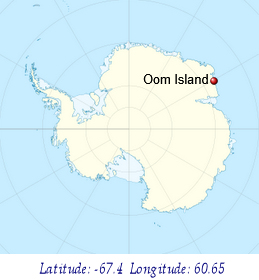 ay is
known to modern Mawson Station researchers for its towering,
spectacular ice cliffs, proximity to the Taylor Glacier, and
occasional massive jade icebergs. A historic commemorative
cairn (designated Historic Site No. 5 under the Antarctic
Treaty) stands on the edge of the bay at Cape Bruce. ay is
known to modern Mawson Station researchers for its towering,
spectacular ice cliffs, proximity to the Taylor Glacier, and
occasional massive jade icebergs. A historic commemorative
cairn (designated Historic Site No. 5 under the Antarctic
Treaty) stands on the edge of the bay at Cape Bruce.
Oom Island is a very small (actual size
unknown), isolated island located just off
the Mac. Robertson Land coast. It sits approximately 0.93
kilometers (0.5 nautical miles) northeast of Campbell Head,
placing it right at the western entrance of Oom Bay. The
island was originally mapped from aerial photographs by
Norwegian cartographers during the Lars Christensen
Expedition (1936–37), who initially named it Uksoy. It was
later officially renamed Oom Island by the Antarctic Names
Committee of Australia (ANCA) to permanently align the
island's nomenclature with the adjacent bay.
Karl Erik
Oom died of pulmonary thrombosis on 22 June 1972 at his
Turlinjah home and was buried with Anglican rites in Moruya
cemetery. His wife survived him. Sources:
Australian War Memorial
Australian Dictionary of Biography
Australian Antarctice Data Centre
Sea Power Centre
Naval Historical Society of Australia
Compiled by Laurie Pegler |