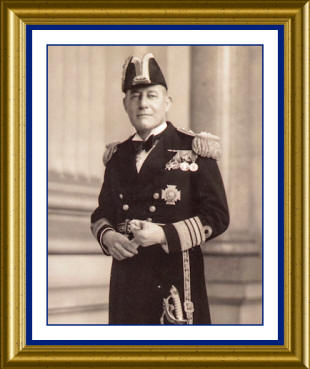
Admiral Sir George Francis HYDE, KCB CVO CBE MiD
 The
majority of the more senior retired officers of the Royal
Australian Navy consider that the late Admiral Sir George
Francis Hyde was the foremost of a group of early senior
members of the Permanent Naval Force who joined in early
years from a variety of seafaring backgrounds.
After early years in the merchant service and as a Royal
Naval Reservist, Hyde entered the Royal Navy as a
Lieutenant. After transferring to the Royal Australian
Navy, Hyde rose to become the first member of the PNF to fly
his flag afloat in command of the Australian Squadron, the
first member of the PNF to command a ship of the Royal Navy,
the first and only RAN Flag Officer to fly his flag afloat
in command of a Royal Navy Squadron, the only RAN Officer to
be created KCB, the first member of the PNF to achieve the
rank of full Admiral on the active list, and the first
seagoing flag officer of the RAN to become professional head
of his service.
George Francis Hyde was born at Portsmouth on 19th July
1877. At the age of 17, he went to sea as an
apprentice in the steel clipper Mount Stewart,
completing several round voyages from London to Sydney, with
wool as the westward cargo and general cargo to Australia.
It was a tough start to a seafaring lifetime, at a time when
the going rate for an apprentice was three pounds per annum.
Hyde’s diaries, describing part of his time in Mount
Stewart, have been preserved in part and make
interesting reading in much the same way as a Midshipman’s
journal – descriptions of nautical events of the passage,
other ships sighted, and different types of fauna noted.
Wool clippers took substantially longer than modern
merchantmen to make the round voyage. Hyde describes
one round voyage from London to Sydney and back of over ten
months’ duration.
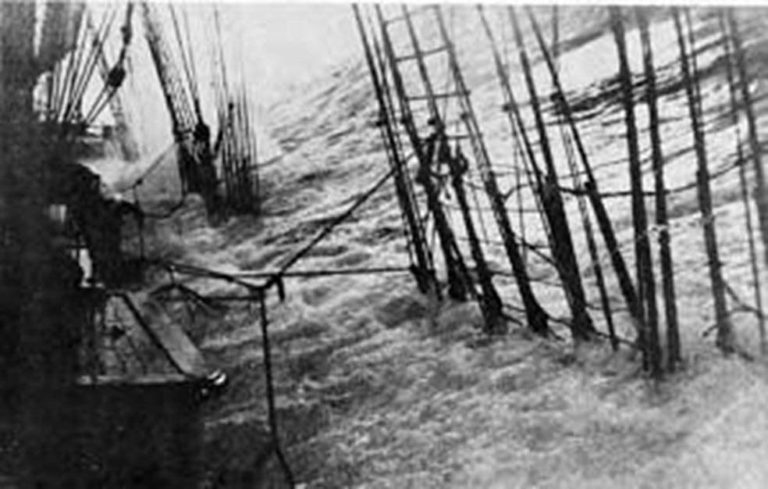
Angry seas sweep the deck of
the three-masted sailing ship Mount Vernon as she rounds
Cape Horn.
After four years in Mount Stewart, Hyde joined the
barque Amulree as second mate in 1898.
Amulree sailed to South America and Australia.
Hyde remained in her until 1899.
During his apprenticeship in 1896, Hyde joined the Royal
Naval Reserve as a Midshipman. In January 1900, by
then an acting Sub-Lieutenant, Hyde joined the Gunnery
School HMS Excellent for the first of a series of
courses to qualify as a confirmed Sub-Lieutenant, RNR.
In February 1901, Hyde joined HMS Tribune, in which
he served for 15 months before transferring to HMS
Thistle for ten days only. Hyde moved to the
battleships Magnificent (1902) and Victorious(1902-04),
having been promoted Lieutenant, RNR, in 1902, and serving
full time as such until 1904.
It was whilst in Victorious that Hyde wrote an
essay on the subject of "War with Japan", with particular
reference to the Russo-Japanese War, and entered that essay
for a prize offered by Lord Charles Beresford to the
officers of his Lordship’s Fleet for the best essay on that
subject. Hyde was clearly the winner of the
competition, which as he was a Lieutenant RNR, made a very
favourable impression upon his Commander in Chief, Admiral
Lord Charles Beresford.
Lord Charles wrote a very strong recommendation to the
Admiralty that Hyde be entered in the Royal Navy with his
seniority as Lieutenant RNR. Thus, it came about that,
contrary to some reports, Hyde did not enter the Royal Navy
as one of the ‘Hungry Hundred’, and was not placed under the
publicly stated limitations for promotion that were imposed
upon that group of RNR Officers who transferred to the Royal
Navy at about the same time as Hyde.
After three months in the cruiser HMS Bacchante,
Hyde began two years as a watchkeeper in the Armoured
Cruiser HMS Leviathan, flagship of Rear Admiral the
Hon. Hedworth Lambton’s Third Cruiser Squadron in the
Mediterranean Fleet. Hyde’s first and second commands
followed (HM Torpedo Boat Number Six for 15 months,
and the Torpedo Boat Destroyer Pother for 13
months).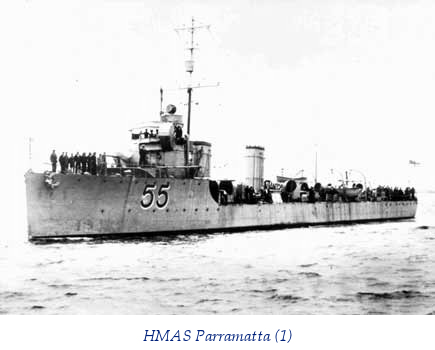
Hyde’s first association with the newborn RAN began as soon
as he left HMS Shannon, when he was appointed
Commander (D) to the RAN’s destroyer flotilla, then being
formed. Hyde made a very favourable impression upon
the then Naval Board as, early in 1912, he was approached
and asked to transfer to the Royal Australian Navy on a
permanent basis. In due course, Hyde was formally
placed on the retired list of the Royal Navy, and on 17th
July 1912 Hyde became a Commander, RAN, with seniority of
1st January 1911 (the date he first became associated with
the RAN’s destroyer flotilla). His first RAN ship was
HMAS Parramatta.
Early in 1913, Hyde left for the United Kingdom to become
Executive Officer of the battle cruiser HMAS Australia,
then completing to become the RAN’s first flagship.
Hyde participated in Australia’s activities in the
early months of World War I, in the Pacific and the West
Indies, leaving the ship three months after she hoisted the
flag of Rear-Admiral W. C. Pakenham (Commanding Second
Battle Cruiser Squadron) at Rosyth in February 1915.
In July 1915 Hyde was appointed in command of the light
cruiser HMS Adventure. That ship served in
the English Channel and in patrol and escort work in the
Western Approaches as the Flagship of Admiral Sir Lewis
Bayly, who commanded in chief in that area. Hyde, in
addition to being Flag Captain, was also Chief Staff
Officer, an invaluable experience. He became a
substantive Captain on 1st April 1917, having acted in the
rank of Captain since assuming command of Adventure,
the first officer of the RAN to command a Royal Navy Ship.
It was during this period that Hyde was awarded an MID for
miscellaneous services in 1917.
Courses in the United Kingdom preceded Hyde’s next command,
that of the cruiser HMS Vindictive, serving in
British waters.
At the end of 1925, Hyde returned to Australia and on 30th
April 1926 hoisted his broad pennant as Commodore (1st
Class) Commanding the Australian Squadron in HMAS Sydney.
Hyde remained in command of the Squadron after his promotion
to Rear Admiral (23rd February 1928) until he hauled down
his flag in May 1929.
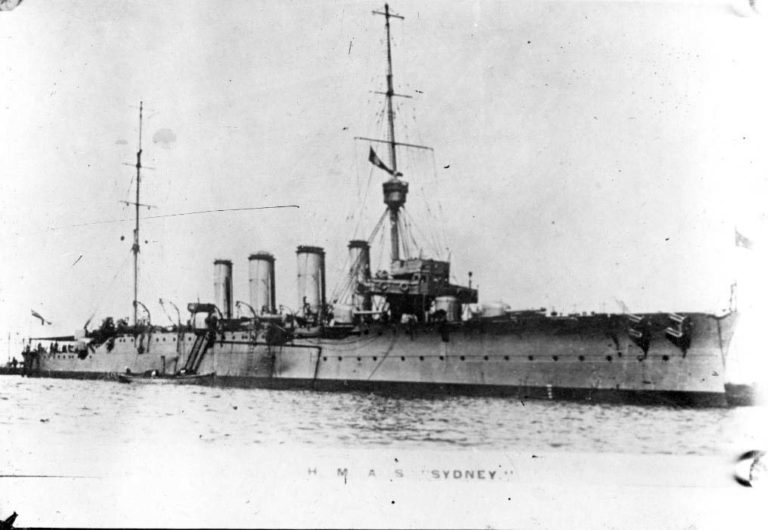
Hyde’s period in command of the Squadron was typical, in
many respects, of peacetime service life of the day – a
Royal Navy Cruiser on exchange, cruises to the New Hebrides,
Hobart, and many other places, exercises off Hervey Bay and
Jervis Bay, destroyers rotating in commission, regattas,
support for civil authorities in time of natural
difficulties such as bush fires.
Highlights of Hyde’s period of command of the Squadron
included escorting the battle-cruiser HMS Repulse
when that ship conveyed Their Royal Highnesses, the Duke and
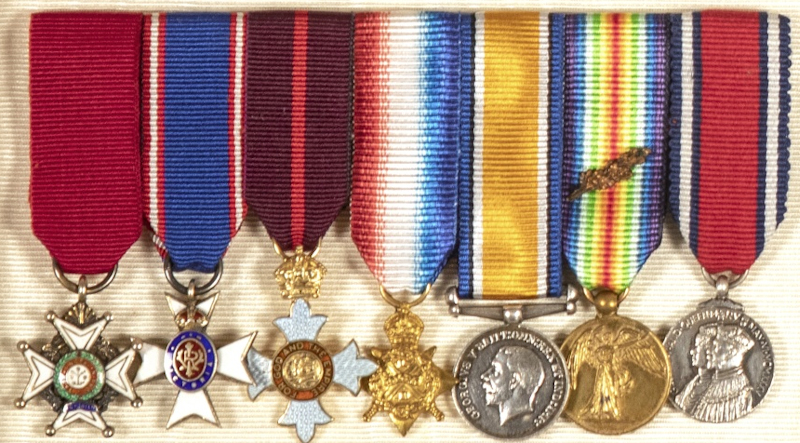
Duchess of York, on a visit to Australia. For his
service to his future King during the visit, Hyde was
created CVO.
As the new heavy cruisers HMA Ships Australia and
Canberra neared completion in the United Kingdom,
Hyde shifted his broad pennant to HMAS Melbourne
and left for the United Kingdom with that ship carrying
officers and sailors for the new cruisers. It was
during the voyage to Europe that Hyde was promoted Rear
Admiral. In May 1928, Hyde hoisted his flag in HMAS
Australia, the first of a long line of Flag
Officers to fly their flags in this ship. After HM
King George V had visited both Australia and Canberra at
Portsmouth, Hyde’s flagship left for home via North America,
whilst Canberra came home via South Africa.
Australia’s voyage included visits to Canada,
Boston, New York, Annapolis and New Zealand before arrival
at Brisbane.
After relinquishing command of the Squadron, Hyde was
married in 1929 to Miss Isla Robertson, daughter of Mr. M.
Robertson of Jandra, NSW. Best man at his wedding was
Lieutenant Commander (now Captain RAN retired) J. B. Foley,
CBE, RAN. Foley had been appointed Secretary to
Commodore Hyde when the latter became Second Naval Member in
1923, and continued to serve with Admiral Hyde in every
major post – both ashore and afloat, at home and abroad,
thereafter. This was a very remarkable association
lasting for 14 years.
After taking leave due, Hyde proceeded to the United Kingdom
to hoist his flag in the battleship Emperor of India
as Rear Admiral of the Royal Navy’s Third Battle Squadron.
During his period of command, Hyde shifted his flag to the
battleship HMS Marlborough.
This command, of a main fleet battle squadron of the Royal
Navy, was indicative of the very high regard in which Hyde
was held not only in Australia, but also in the United
Kingdom.
Hyde took advantage of this visit to the United Kingdom to
visit many Royal Navy shore installations and, particularly,
to see as much as he could of the functions and personnel of
the Admiralty. Hyde served as Australia’s naval
adviser at the 1930 London Naval Treaty Conference.
After a period in the Admiralty, gaining knowledge of the
functions of various Admiralty Divisions, Hyde returned to
Australia and in October 1931 became First Naval Member of
the Commonwealth Naval Board – the professional head of the
RAN. Promotion to Vice Admiral came in November 1932,
and to full Admiral on 12th July 1936 – the first seagoing
member of the RAN to hold this rank and office. In the
1937 New Year Honours, Hyde was created KCB, the only RAN
Officer ever to achieve that honour.
Hyde’s period as First Naval Member was probably the most
difficult and frustrating of his whole life. Economic
problems resulted in the Government of the day running down
the strength of the RAN, in fact, of all the defence
services. Hyde had to preside over the paying off of
the new seaplane carrier HMAS Albatross, the
disbandment of the RAN’s submarine service and the premature
discharge of 700 officers and sailors. He even had to
fight off suggestions of the total disbandment of the RAN,
made in the Parliament by some members of the then Labour
Opposition. It was a difficult task to maintain morale
and a small but solid base of 3,000 trained personnel upon
which the RAN could be rebuilt for World War II. It is
greatly to Hyde’s credit that he overcame the transition
from command afloat to the very different political and
public service surroundings of Melbourne and played a
leading part in the early stages of rebuilding the RAN,
towards the end of his period as the professional head of
his service.
Hyde’s conviction that the RAN would be needed was
reinforced by what he learned when he served as adviser at
the 1935 London Naval Conference. Hyde’s foresight
enabled him to recognise that war with Germany was a virtual
certainty, and that with Japan probable. This
knowledge was a driving force in Hyde’s claim that the RAN
needed modern cruisers, and in the many other steps that
Hyde took during the last two years before his death.
Hyde saw the replacement of the ageing cruiser HMAS
Brisbane by the new HMAS Sydney, the
acquisition of five replacement destroyers for the ‘S’
Class, and an increase in personnel which facilitated the
retaining in commission of a higher proportion of the Fleet.
A firm but just man, Hyde had the naval officer’s
traditional dislike of publicity. Hyde’s modesty must
have made political and public service surroundings as
difficult for him as they are for many other naval officers.
Hyde was wholly committed to the RAN, for which he worked
unremittingly. For Hyde, every day except Christmas
Day, Good Friday, and Sundays, were normal working days.
As can be imagined, a similar devotion was expected of, and
gladly given, by his personal staff, to whom he could and
did show great personal kindness.
Hyde had been appointed originally as First Naval Member for
a period of five years. This was subsequently extended
for a further one year. Accordingly, early in 1937
arrangements were made for Hyde to be replaced by Vice
Admiral Sir Ragnar Colvin, late in 1937. However, in
mid July, Hyde developed bronchial pneumonia and died on the
afternoon of 28th July, in a Melbourne private hospital.
His modesty remained with him to the end – at his own
request his funeral at Springvale was private, with no
flowers.
By any measure, Hyde’s career was successful in command
afloat and as professional head of his Service. The rank of
full Admiral in the RAN had been achieved by only two
officers during the first 60 years of the RAN’s existence.
It was to be 33 years after Hyde’s death before the first
graduate of the RAN College climbed the full height of the
RAN ladder to become a full Admiral RAN – Admiral Sir Victor
A. T. Smith, KBE, CB, DSC, was promoted to that rank on 23rd
November 1970, when he became Chairman of the Chiefs of
Staff Committee.
.
Sources:
Naval Historical Society of Australia
Wikitree
Bravo Zulu Vol.1
Compiled by Laurie Pegler |