Captain Gerhard Heinrich HEYEN MBE
Lieutenant Commander MiD RD U.S. Legion Of Merit(O) RANR (S)
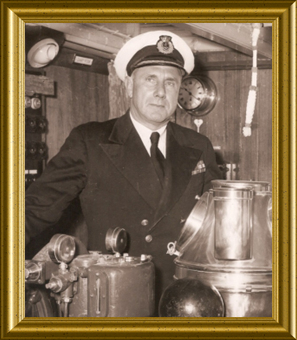 Gerhard
Heinrich Heyen was descended from a Danish family
of mariners whose origins are traced to the Frisian
Islands and the town of Papenburg in northwest
Germany. His father migrated to South Australia in
1896, and soon commanded the SS Kintore, a coastal
vessel operated by Dalgety & Co. She was a
workhorse of the Spencer Gulf and Gulf St Vincent
trade, moving grain, wool, and minerals. Gerhard
Heinrich Heyen was descended from a Danish family
of mariners whose origins are traced to the Frisian
Islands and the town of Papenburg in northwest
Germany. His father migrated to South Australia in
1896, and soon commanded the SS Kintore, a coastal
vessel operated by Dalgety & Co. She was a
workhorse of the Spencer Gulf and Gulf St Vincent
trade, moving grain, wool, and minerals.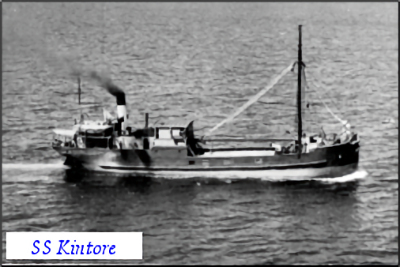
Gerhard was born in Port Adelaide in 1900,
and went to sea in Bass Strait ketches at the age
of 13. He was indentured at age 14 to his father as
a boy seaman on the Kintore and got his second
mates’ certificate at the age of 18 on that ship.
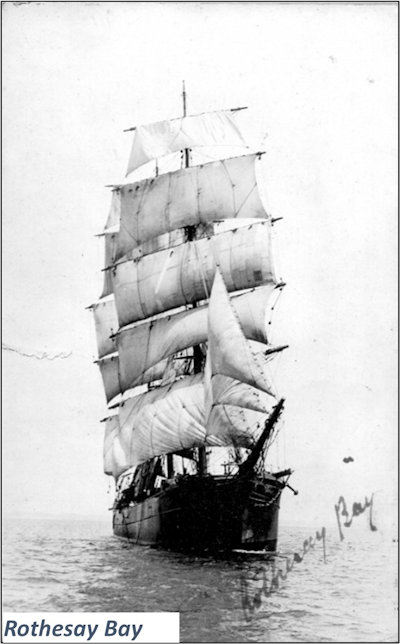
Soon he moved into square-rigged sailing ships
including the brigantine Woolamai, the barque
Wildwave and the Rothesay Bay. Next, he joined
Burns Philp as fourth mate of the TSS Marella, but
soon transferred to Suva to go as mate of the
schooner Samoa, running to Wallis, Futuna and
Rotuma and then around the Gilbert Islands.
 He was then granted his Master Mariner’s
certificate in 1924, and went as mate of the
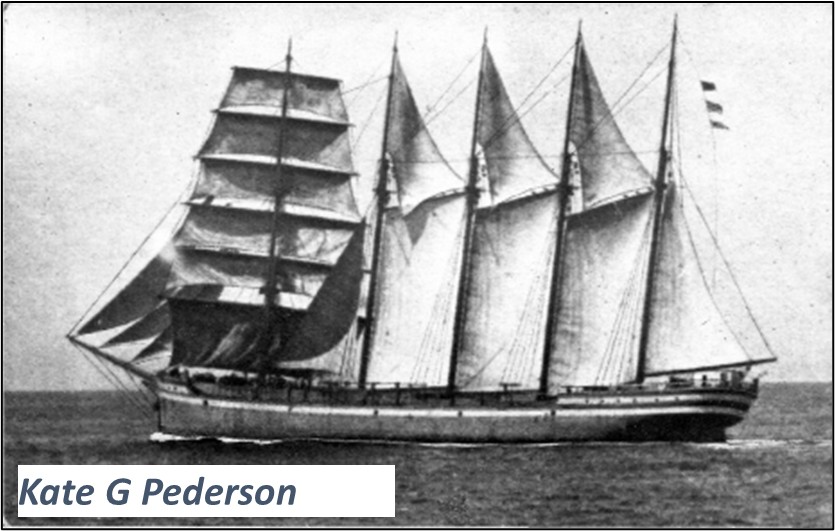
five-masted barquentine, Kate G Pedersen, sailing
from San Francisco to Australia carrying Canadian
lumber for the Australian market. He was then granted his Master Mariner’s
certificate in 1924, and went as mate of the
five-masted barquentine, Kate G Pedersen, sailing
from San Francisco to Australia carrying Canadian
lumber for the Australian market.
When he next reached Australia, he found business
bad and sailed on the coast as a stockman, in the
ships Dimboola and Mallina, taking sheep to the
west and to Queensland.
A central theme in Gerhard Heyen’s life—and a key
to his wartime contribution—is the hydrography
which he learned in his birthplace. Port Adelaide
is famous among oceanographers for a tidal
phenomenon known as the "dodging tide". In most
coastal regions, tides are semi-diurnal, rising and
falling twice a day due to the gravitational pull
of the moon and sun. However, the Gulf St Vincent
has a specific resonance that interacts with these
gravitational forces. During the neap tides (when
the sun and moon are at right angles to the earth),
the solar and lunar constituents of the tide in
this region are of equal amplitude but opposite
phase. The result is a hydrographic standoff. The
tide does not rise or fall; it "dodges." The water
level can remain effectively static for twenty-four
hours or engage in erratic, minor fluctuations that
defy standard prediction tables.
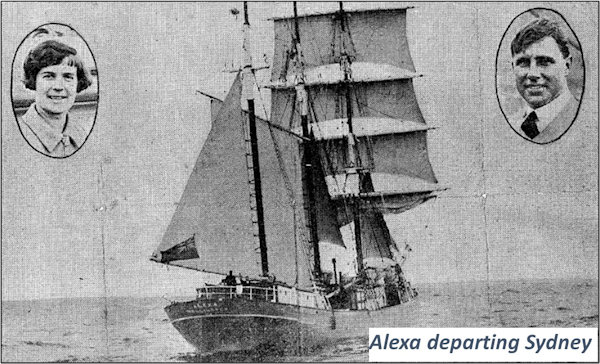 Newly married in 1926, Gerhard was given command of
the steel-hulled barque Alexa to carry general
cargo to the Gilbert Islands and bring copra back
to Australia. As custom allowed, he signed his wife
Hilda on as Ship’s Cook and she accompanied him on
these voyages. He was employed by On Chong & Co., a
major Chinese-Australian trading house based in
Sydney, who dominated the trade in the Gilbert
Islands (now Kiribati). Newly married in 1926, Gerhard was given command of
the steel-hulled barque Alexa to carry general
cargo to the Gilbert Islands and bring copra back
to Australia. As custom allowed, he signed his wife
Hilda on as Ship’s Cook and she accompanied him on
these voyages. He was employed by On Chong & Co., a
major Chinese-Australian trading house based in
Sydney, who dominated the trade in the Gilbert
Islands (now Kiribati).
This trade required a unique set of skills. The
Gilbert Islands are low-lying coral atolls with
treacherous fringing reefs and few natural
harbours. Loading cargo often involved lying
offshore and ferrying goods through the surf—a
dangerous operation requiring precise ship
handling. Gerhard’s tenure in the Gilberts was
immersive. He did not merely visit the islands; he
lived there. His base of operations was Butaritari
(Makin Atoll), which was then the administrative
and commercial hub of the northern Gilberts. He was
"adopted into the royal family" of Butaritari. This
was not a trivial gesture; in Gilbertese culture,
it signified an acceptance into the kinship
network, granting him access to local knowledge,
oral histories, and a deep understanding of the
reef systems that no chart could provide.
During this time, Heyen observed the tides in the
lagoons of the Gilbert Islands exhibited the same
"dodging" behaviour he had known in South
Australia. The water would stand still for hours,
defying the standard Admiralty tide tables. He
mentally filed this information away—a hydrographic
curiosity that would emerge years later.
The Alexa was historically significant as the last
sailing vessel to operate regularly out of Sydney
to the Pacific Islands. In an age where coal and
oil were king, Heyen was proving the economic
efficiency of wind power for long-haul, low-margin
cargoes like copra. For six of his years in the
Gilberts, his wife sailed with him and he compiled
the official Sailing Directions for the Gilbert
Islands. When the Alexa was burnt out at Butariti
in 1929, he took command of the SS Macquarie, also
for On Chong & Co.
Gerhard was in a prime position to observe the
activities of the Japanese in their post-World War
One mandated territory of the Marianas, Marshall,
Caroline and Palau Groups of islands. Contrary to
the conditions attached to the Mandates issued by
the League of Nations, Japan was using the
territory for its own improvement, not that of the
island populations. More importantly, it was also
using the territory to build its naval capability
in the Pacific. He recognised what was happening
and started sending reports on these activities and
information on tides, weather and hydrography to
Australian, New Zealand and US Naval Intelligence
authorities.
As tensions rose in Europe and the Pacific in the
mid-1930s, Australia began to look to its merchant
marine to bolster its naval defences. In August
1935, Gerhard Heyen enlisted in the Royal
Australian Navy Reserve (Seagoing Branch) in
Sydney. His experience and qualification as a
Master Mariner immediately earned him the rank of
Lieutenant. He did early naval training at HMAS
Cerberus in Navigation and Gunnery, followed by
seagoing stints in HMA Ships Canberra and
Vampire. He had rejoined Burns Philp during this period and
was running the phosphate ships Triaster and
Triadic.
When war was declared in September 1939, Heyen was
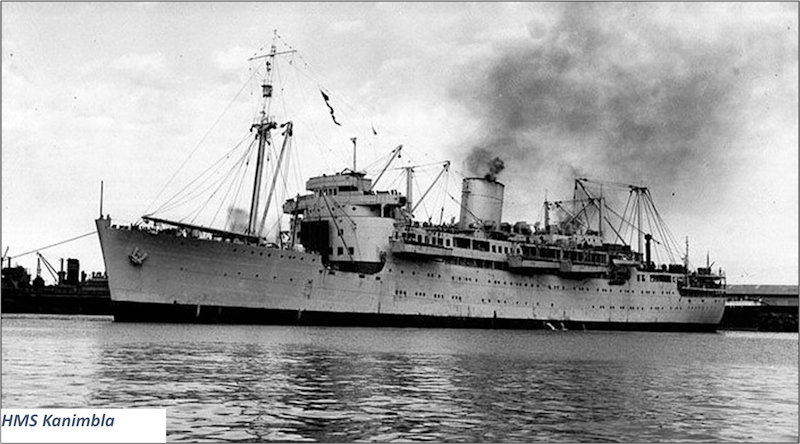
immediately mobilised. He was assigned as Navigator
of HMS Kanimbla, a converted passenger liner that
carried 350 passengers and mixed cargo. Requisitioned by the British Admiralty, she was
fitted with 6-inch guns and was thus an Armed
Merchant Cruiser. These vessels were the "wolves in
sheep's clothing" of the fleet, tasked with
patrolling the vast trade routes of the Indian and
Pacific Oceans to intercept German commerce raiders
and blockade runners. The Royal Navy initially sent
the ship to the Far East Station to intercept ships
carrying war-related contraband between America and
Vladivostok.
During the interception of the Russian ship V.
Mayakovsky after intelligence was received that it
was carrying contraband, LEUT Heyen, as an
experienced sailor and the ship’s Navigation
Officer, was often required to navigate the ship.
During this operation he was at the helm in rough
seas and for the difficult task of taking the
captured ship on tow. He was awarded a Mention in
Despatches (MID) for his excellent service during
this period. The MID denoted gallant or meritorious
action in the face of the enemy. He was promoted to
Lieutenant Commander RANR (Seagoing) in August
1940.
In 1941 Kanimbla transferred to the Indian Ocean
and led the attack on the port of Bandar Shapur in
the Persian Gulf on 24 August 1941. Carrying 300
Gurkha soldiers the invaders captured the port and
eight German and Italian vessels. Kanimbla returned
to Australia where it was transferred to the Royal
Australian Navy and assumed the “HMAS” prefix.
Despite Gerhard’s success, the rigors of naval
service took a physical toll. An old injury, likely
a legacy of his years in sail or the hard labour of
the island trade, was aggravated during his time in
Kanimbla. The RAN medical board declared him
medically unfit for seagoing duty in late 1941. His
file says he was ”approved to be employed in a
shore establishment, preferably in a sedentary
occupation, for the duration of the war.” But fate
had a few other cards to deal him!
After a brief period at Cerberus, LCDR Heyen was
posted to HMAS Lonsdale at Port Melbourne as the
Principal Naval Recruiting Officer in March 1942. During his time ashore, his pre-war fears were
realised and Japan commenced hostilities in the
Pacific soon after Pearl Harbour on 7 December
1941. After 18 months as Recruiting Officer, he was
approached by Commander R.B.M. Long RAN, the
Director of Naval Intelligence, who proposed that
his pre-war knowledge of the Southwest and Central
Pacific islands, particularly the Gilberts, would
be invaluable for US planning for “Operation
Galvanic”—the seizure of the Gilbert Islands. Thus
in August 1943, he was assigned to HMAS Moreton in
Brisbane for “Special Duties”.
 The primary US target was Tarawa Atoll,
specifically the island of Betio, which the
Japanese had turned into a fortress. The US Navy
faced a major intelligence gap. The charts of the
Gilberts were based on surveys from the mid-19th
century. They lacked detail on the reefs that
fringed the islands. Yet the success of the
amphibious assault depended on the Higgins boats
(LCVPs) being able to cross the reef to land
Marines on the beach. They needed at least four
feet of water over the reef. The primary US target was Tarawa Atoll,
specifically the island of Betio, which the
Japanese had turned into a fortress. The US Navy
faced a major intelligence gap. The charts of the
Gilberts were based on surveys from the mid-19th
century. They lacked detail on the reefs that
fringed the islands. Yet the success of the
amphibious assault depended on the Higgins boats
(LCVPs) being able to cross the reef to land
Marines on the beach. They needed at least four
feet of water over the reef.
US Naval Intelligence began a desperate search for
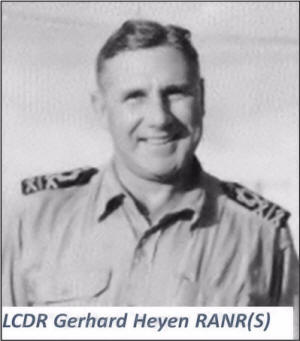
anyone who had lived in or navigated the Gilberts. Among them, LCDR Gerhard Heyen stood out. He was
not just a resident; he was a Master Mariner who
had commanded ships in those waters for years. He
was therefore soon seconded to the US forces.
Attached to the Fifth Amphibious Force under
Admiral R.K. “Terrible” Turner, LCDR Heyen was put
in charge of the “Foreign Legion,” as it was known. This consisted of former merchant seamen from
Australia and New Zealand, British planters and
civil servants from the Gilberts and Gilbertese
islanders.
They needed to provide as much information as
possible to the invasion planners on local
conditions on land and the sea approaches for
“Operation Galvanic”. Heyen’s topographical
knowledge was invaluable. But his most critical
contribution concerned the tides.
US planners, relying on standard harmonic
predictions, estimated that there would be
sufficient water over the reef on the proposed
D-Day (November 20, 1943). Heyen demurred. Drawing
on his memory of Port Adelaide’s "dodging tides"
and his observations of the similar phenomenon in
the Gilberts, he warned that tides in the lagoon
were unpredictable. He explained that during the
neap phase, the tide might not rise as predicted—it
might "dodge," staying low and exposing the reef
for hours.
 Tragically, the warning could not fully mitigate
the risk. On D-Day, the "dodging tide" occurred as
he predicted - the water did not rise high enough.
The US Navy Higgins boats slammed into the reef
hundreds of yards from shore and Marines were
forced to wade through chest-deep water under
withering Japanese machine-gun fire. Casualties
were horrific. Tragically, the warning could not fully mitigate
the risk. On D-Day, the "dodging tide" occurred as
he predicted - the water did not rise high enough.
The US Navy Higgins boats slammed into the reef
hundreds of yards from shore and Marines were
forced to wade through chest-deep water under
withering Japanese machine-gun fire. Casualties
were horrific.
Tarawa was recognised as a very bloody battle
despite the planning but, while this was going on,
LCDR Heyen was watching the concurrent landing at
Makin Atoll (Butaritari) and his old life came back
to him. On the beach was the hulk of the Alexa that
had been turned into a machinegun nest by the
Japanese and nearby his former house that had been
fortified and made into their area headquarters. He
watched with sadness as US ships systematically
pulverised these with their big guns. Yet while the
outcome was bloody, Heyen’s input had forced the
planners to at least consider the contingency,
leading to the prioritisation of LVTs (Landing
Vehicle Tracked)—amphibious tractors that could
crawl over the reef. Without these, the landing
might have failed entirely. Heyen’s "dodging tide"
theory was proven in the most brutal crucible
imaginable.
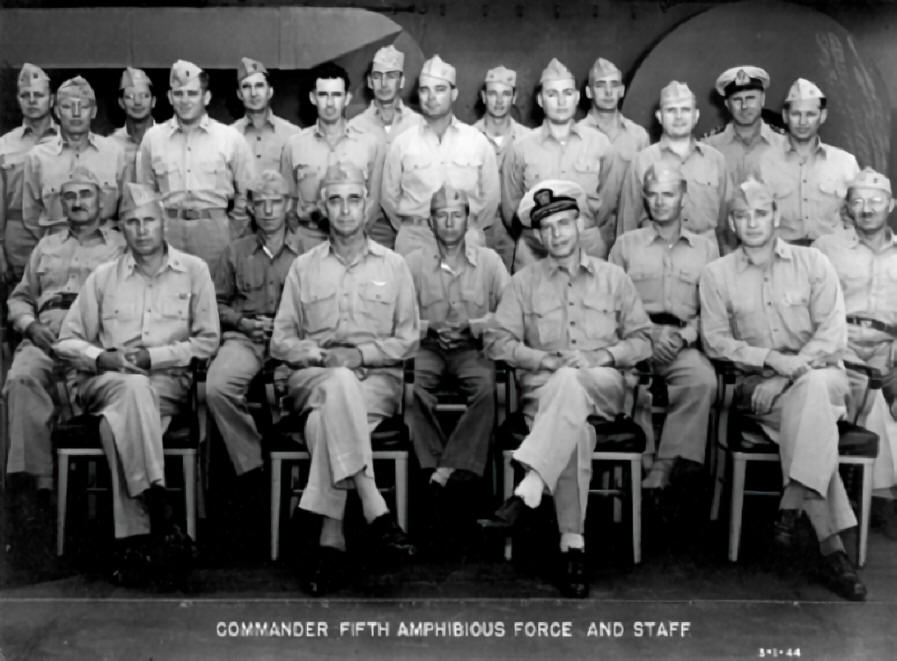
The Foreign Legion was disbanded once “Operation
Galvanic” ended, but Admiral Turner
prevailed upon
the RAN to allow LCDR Heyen to remain with him for
the remainder of the war.
Photo dated 3 Jan 44. LCDR Heyer is second from
right back row.
Following the Gilberts campaign, Heyen’s knowledge
was recognised as invaluable. He effectively ceased
operating as a standard RAN officer and became a
specialist integrated within the US amphibious
command structure at sea. His role was to guide
various ships through the treacherous waters of the
Western Pacific. Records indicate that Heyen took
part in a staggering number of amphibious landings,
notably:
-
Kwajalein (1 February 1944), Eniwetok (18
February 1944), Saipan (15 June 1944), then
-
Tinian (Mariana Islands) - July 24, 1944:
Following the capture of Saipan, Heyen assisted in
the shore-to-shore assault on Tinian. His knowledge
of reef approaches was crucial for the surprise
landing on the narrow "White Beaches" in the north
of the island.
-
Peleliu (Palau Islands) - September 15, 1944: One
of the most bitter battles of the war. The approach
to Peleliu involved navigating complex coral
barriers. Heyen’s guidance helped the Marines land,
though the inland fighting was ferocious.
-
Leyte (Philippines) - October 20, 1944:
MacArthur’s return. Heyen navigated the landing
craft into Leyte Gulf, a massive operation that
triggered the largest naval battle in history.
-
Iwo Jima (Bonin Islands) - February 19, 1945:
Heyen was present at the "Black Sands" of Iwo Jima. The navigational challenge here was less about
reefs and more about the steep gradients and the
heavy surf.
-
Okinawa (Ryukyu Islands) - April 1, 1945: The
final and largest amphibious assault of the war.
Heyen navigated the forces to the Hagushi
anchorage.
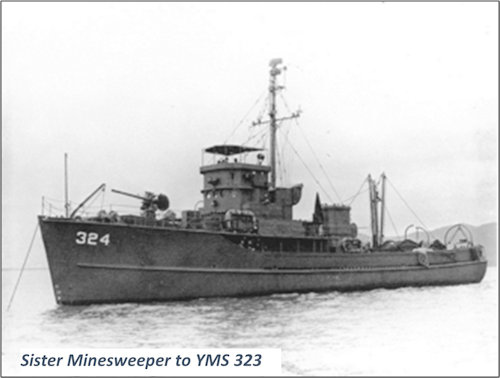 At Saipan on 15 June, he boarded the minesweeper
YMS 323, in charge of a mobile hydrographic unit
undertaking inshore reconnaissance. A few days
later, the ship was fired on by a Japanese shore
battery and five 6-inch shells hit the ship, one of
which incapacitated the Commanding Officer. LCDR
Heyen was immediately obliged to take command and
navigate the ship out of danger to effect damage
repairs. He may have been the first Australian
naval officer to command an American warship under
fire. At Saipan on 15 June, he boarded the minesweeper
YMS 323, in charge of a mobile hydrographic unit
undertaking inshore reconnaissance. A few days
later, the ship was fired on by a Japanese shore
battery and five 6-inch shells hit the ship, one of
which incapacitated the Commanding Officer. LCDR
Heyen was immediately obliged to take command and
navigate the ship out of danger to effect damage
repairs. He may have been the first Australian
naval officer to command an American warship under
fire.
Following earlier landings, concern had been
expressed that the pre-landing bombardments had
done insufficient damage to enemy fortifications
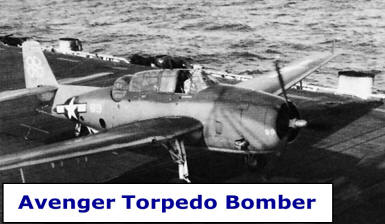
and underground bunkers. At Peleliu, prior to the
planned landing, he crossed to the aircraft carrier
USS Kadashan Bay and boarded an Avenger torpedo
bomber as observer. According to a newspaper
interview Heyen gave after the war, the aircraft
flew up and down the proposed landing area and rear
areas at a height of about fifty feet to enable him
to assess damage from the naval bombardment. Subjected to heavy anti-aircraft fire, the plane
flew back and forth over the area until safely
returning to the carrier.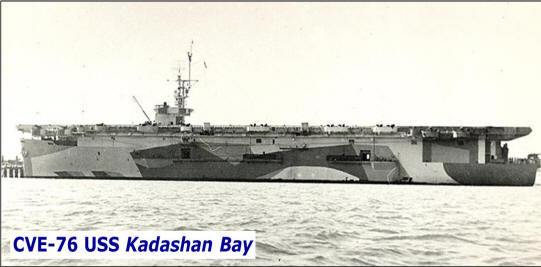
 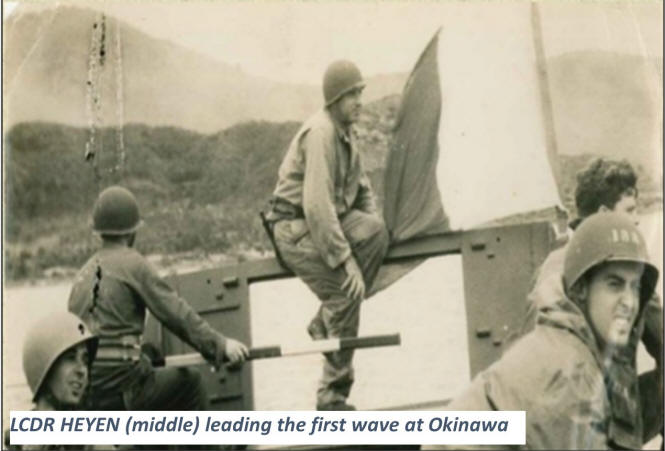 In many of these operations, he served as the First
Wave Navigation Officer. This role involved being
on the lead control vessel, navigating the assault
waves through the reef passes and onto the correct
beach sectors while under fire. In many of these operations, he served as the First
Wave Navigation Officer. This role involved being
on the lead control vessel, navigating the assault
waves through the reef passes and onto the correct
beach sectors while under fire.
By August 1945, Heyen was in Manila, in the
planning cells for “Operation Olympic”—the invasion
of Kyushu, the southern island of Japan. This was
expected to be the bloodiest campaign of the war. Heyen’s expertise would have been used to map the
landing beaches of Miyazaki and Ariake Bay. The
dropping of the atomic bombs on Hiroshima and
Nagasaki and the subsequent Japanese surrender on
August 15, 1945, spared Heyen and millions of
others from this final horror.
By the end of the Pacific Campaigns, he had
participated in the planning and execution of
numerous violently opposed amphibious landings,
some from extremely exposed positions. The US
Government recognised Heyen’s extraordinary courage
and contribution with the award of the Legion of
Merit (Officer).
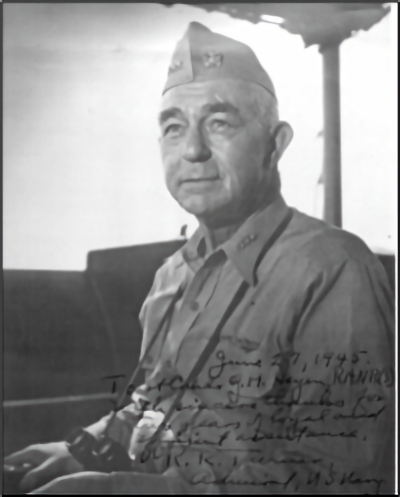
This photo was personally annotated by Admiral
Turner:
“June 27 1945.
To LCDR GH Heyen RANR (S).
With sincere thanks for two years of
loyal and
efficient assistance.
RK Turner, Admiral US Navy”
LCDR Heyen was transferred to the RAN Retired List
as a Lieutenant Commander on reaching retiring age
on 30 May 1945. He was soon released from his
assignment with the US Navy and returned to
Australia where he was eventually demobbed in
December that year.
Surprisingly, his next venture was a shark fishing
ketch off the South Australian coast. This became a
total loss in the Bight during a southerly gale, so
he took a job delivering the bomb scow Kerema to
Port Moresby.
Back in Australia, he was selected to take up the
post as Marine Superintendent for the Territory of
Papua New Guinea. Based in Rabaul with his merchant
seaman’s rank of Captain reinstated, his primary
responsibility was to re-establish the Papua New
Guinea coastal shipping service.
He left after 18 months due to fever, and joined
the Australian Shipping Board as mate, and later as
master, of the SS Ransdorp which he collected from
Holland and fitted out in London. He then went as
master of another vessel until he was reportedly
called into Navy Office in Melbourne during the
Korean war to assist with planning, in the unlikely
event an amphibious landing was required.
In 1955, Captain Heyen took up the position as
Marine Superintendent for the Australian National
Line to oversee its coastal shipping operations in
Australia.
Having settled in Melbourne, it was here that he
became involved in the campaign to save and restore
the derelict hulk of the iron barque Polly
Woodside, formally the Rona, which was destined to
be scuttled after ending its life as a coal barge. Restoration was being proposed by the National
Trust, with a request that the Victorian State
Government provide funds for the project. Captain
Heyen was requested to undertake a marine survey on
the hulk to determine the viability of the
proposal. His report was the basis for the approval
and he was then appointed to the Restoration
Committee once approval was given to proceed.
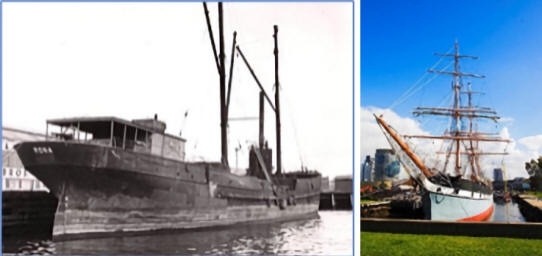 He was uniquely qualified, having commanded a
similar vessel commercially. Working closely with a
Master Rigger, a former able seaman and sailmaker,
they re-masted and re-rigged the Polly Woodside at
the Duke and Orr’s Dry Dock. He was uniquely qualified, having commanded a
similar vessel commercially. Working closely with a
Master Rigger, a former able seaman and sailmaker,
they re-masted and re-rigged the Polly Woodside at
the Duke and Orr’s Dry Dock.
When the restoration project was completed and the
Polly Woodside launched, albeit in the Dukes and
Orr’s dry-dock, Captain Heyen was honoured by being
appointed as its Master. The ship opened to the
public in 1978.
Gerhard Heyen was subsequently honoured as a Member
of the British Empire (MBE) in January 1980 for...
...his
services to the Melbourne Maritime Museum in the
preservation of the Polly Woodside.
This is the first
medal in the impressive array he accumulated in his
career.
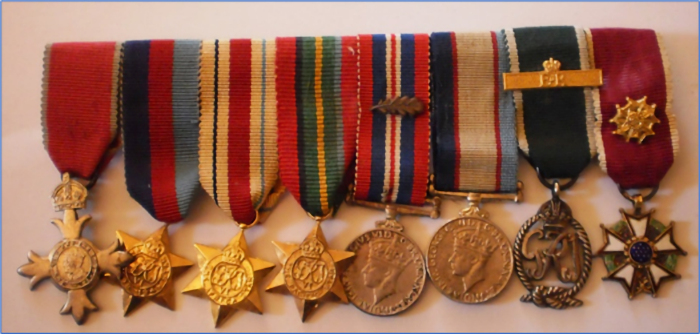
Decorations and Awards
Australian Awards
1939-1945 Star
Africa Star
Pacific Star
1939-1945 War Medal (including Oak Leaf for Mention
in Despatches)
Australian Service Medal
Reserve Officers Decoration
United States Awards (* latter two entitled but not
received)
Legion of Merit (Officer Division)
*
Philippines Liberation Medal
*
Asiatic Pacific Campaign Medal (with seven stars
and arrowhead)
Captain Gerhard Heinrich Heyen died on 29 December
1980. His legacy stands preserved in the iron hull
of the Polly Woodside and in the naval archives of
two nations, a testament to the enduring peacetime
and wartime contribution of this impressive and
heroic Master Mariner.
Sources:
The Navy Victoria Network acknowledge the
assistance of Mr Ross Wilkinson, as custodian of the Heyen
Family collection, for making available much of the material
in this account of an unsung Navy Hero.
Compiled by Captain Andrew Mackinnon CSC
RAN Rtd. and Laurie Pegler OAM |