Read Admiral Harold Bruce FARNCOMB
CB DSO MVO MiD** US Navy Cross, US Legion of Merit
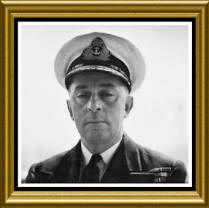 Harold
Bruce Farncomb (1899-1971), naval officer and lawyer, was
born on 28 February 1899 in North Sydney, second child of
Frank Farncomb, a timber surveyor from England, and his
Victorian-born wife Helen Louisa, née Sampson. He was
educated at
Gordon Public and Sydney Boys' High schools. In 1913, Harold
was among the first intake at the Royal Australian Naval
College, Osborne House, Geelong, Victoria. He did
well academically, gained colours for cricket and topped his
final year. Harold
Bruce Farncomb (1899-1971), naval officer and lawyer, was
born on 28 February 1899 in North Sydney, second child of
Frank Farncomb, a timber surveyor from England, and his
Victorian-born wife Helen Louisa, née Sampson. He was
educated at
Gordon Public and Sydney Boys' High schools. In 1913, Harold
was among the first intake at the Royal Australian Naval
College, Osborne House, Geelong, Victoria. He did
well academically, gained colours for cricket and topped his
final year.
Promoted Midshipman in January 1917,
Farncomb was immediately sent to Britain for training with
the Royal Navy. His first appointment was to the battleship,
HMS Royal Sovereign in the Grand Fleet based at
Scarpa Flow. He served aboard the vessel for the
remainder of the war, remaining with the ship until shortly
after the Armistice in late 1918.
His performance during this period set the stage for his
promotion to Sub-Lieutenant, after which he attended further
specialist courses at HMS Excellent (Whale Island). In 1920 he was
awarded the maximum of five first-class certificates for his
Lieutenant's courses.
Back home, in 1921-22 he was Gunnery Officer in the
destroyer, HMAS Stalwart. While serving on Commodore
(Sir) Percy Addison's staff in the flagship, Melbourne,
Farncomb was commended for intelligence work during the
fleet's northern cruise in 1922. Next year he sailed for
England and in 1924 graduated from the R.N. Staff College,
Greenwich. Returning to Australia in 1925, he performed
staff duties at sea.
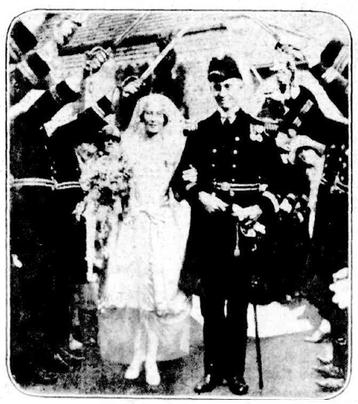
On 31 March 1927 at Trinity
Congregational Church, Strathfield, Sydney, he married Jean
Ross Nott; they were to remain childless. Jean provided
staunch support throughout the vicissitudes of her husband's
career.
Promoted Lieutenant Commander in 1927, Farncomb attended the
Imperial Defence College, London, at the unusually young age
of 31. While posted to Navy Office, Melbourne, he was
promoted Commander on 30 June 1932. He joined the heavy
cruiser, HMAS Australia, as Executive Officer in April
1933. Strict but fair, he fostered high morale in the ship. With her
Midshipmen, he was curt yet considerate, usually
addressing them as 'Mr Bloody . . . '; they nicknamed him
'Uncle Hal'. The Commanding Officer, Captain W.S.F.
Macleod, RN, was impressed by his ability and recommended
him for accelerated promotion. In December 1934 the Duke of
Gloucester embarked in Australia on his voyage to England,
following which Farncomb was appointed MVO in 1935.
From August 1935 he was attached to the Naval Intelligence
Division at the Admiralty. By 1937 he thought that war with
Germany was inevitable, and took leave to visit that country
and improve his knowledge of the language. On 30 June 1937
Farncomb was the first RANC graduate to be promoted
Captain. Home again, he commanded the sloop, HMAS Yarra
(October 1937 to November 1938), then went back to England
to commission the cruiser, HMAS Perth in June 1939.
The ship was in the western Atlantic en route to Australia
at the outbreak of war in September. She interrupted her
voyage, and for six months patrolled Caribbean and nearby
waters. It was probably at this time that Farncomb acquired
the nickname 'Fearless Frank'. Signalling instructions to a
convoy in the event of an attack, he is reported to have
said:
'My intention is to engage the enemy with my main
armament and close him until I am in torpedo firing range. If gun-fire and torpedoes are not sufficient in disabling
the raider, I intend to ram the enemy ship'.
In June 1940 Farncomb transferred to the heavy cruiser,
Canberra, which spent most of the next eighteen months in
the Indian Ocean escorting convoys and hunting German
raiders, among them the pocket-battleship, Admiral Scheer. On 4 March 1941, south-east of the Seychelles Islands,
Canberra encountered two ships, reported by her aircraft to
be an armed raider and a tanker. The supposed raider ignored
warnings. Canberra opened fire from about 21,000 yards (19.2
km). Farncomb manoeuvred Canberra to keep the range beyond
19,000 yards (17.4 km) in case his adversary carried
torpedoes; firing ceased when the merchant ship was seen to
be burning.
It transpired that Canberra had attacked the enemy
supply-ship, Coburg; the accompanying tanker was the
Ketty
Brovig. Both were scuttled by their crews and sank. Having
interrogated his German prisoners, Farncomb warned the
Admiralty of the Admiral Scheer's projected movements. Papers which later circulated in Navy Office criticised him
for being 'over cautious' in the action: had he approached
nearer to Coburg, he could have saved ammunition. The
adverse reaction to Farncomb's prudent conduct may have
influenced the subsequent behaviour of Captain Joseph
Burnett in HMAS Sydney. His decision in November to
close with the disguised raider, Kormoran, resulted in the
loss of his ship and all on board.
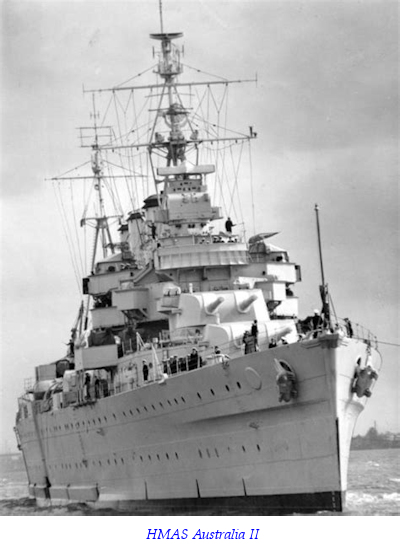 On 24 December 1941 Farncomb joined Australia as Commanding
Officer and Chief Staff Officer to Rear Admiral (Sir) John
Crace. At sea on 12 March 1942, a stoker John Riley was
stabbed. Before he died the following day, he named fellow
stokers Albert Gordon and Edward Elias who, he claimed,
attacked him after he had threatened to report their
homosexual activities. The men were charged with murder. It
was Farncomb's unwanted duty to prosecute at their court
martial, convened on 15 April at Noumea. He studied
available law books and, after a 'masterly' performance,
secured convictions. Gordon and Elias were sentenced to
death. Reverting to the role of Commanding Officer, Farncomb
then submitted an eloquent appeal for their lives; the
sentences were subsequently commuted to imprisonment. On 24 December 1941 Farncomb joined Australia as Commanding
Officer and Chief Staff Officer to Rear Admiral (Sir) John
Crace. At sea on 12 March 1942, a stoker John Riley was
stabbed. Before he died the following day, he named fellow
stokers Albert Gordon and Edward Elias who, he claimed,
attacked him after he had threatened to report their
homosexual activities. The men were charged with murder. It
was Farncomb's unwanted duty to prosecute at their court
martial, convened on 15 April at Noumea. He studied
available law books and, after a 'masterly' performance,
secured convictions. Gordon and Elias were sentenced to
death. Reverting to the role of Commanding Officer, Farncomb
then submitted an eloquent appeal for their lives; the
sentences were subsequently commuted to imprisonment.
Farncomb's tactical brilliance was primarily displayed on 7
May 1942, when Australia and the rest of the Task Force
were sent without air cover to block the Jomard Passage and
intercept the Japanese Port Moresby invasion force.
When 12 Japanese land-based torpedo bombers attacked,
Farncomb handled the 10,000-ton Australia "as
though his heavy cruiser was a destroyer". He threw
the ship into violent, high-speed turns to evade incoming
threats.
During a strike by twin-engined bombers, Farncomb executed a
turn so sharp and timely that enemy torpedoes were seen
running harmlessly down both sides of the ship
simultaneously. Following the standard anti-aircraft
doctrine of the time, the crew moved the ships to face the
incoming bombers directly, which reduced the target area
presented to the enemy and allowed for more concentrated
anti-aircraft fire.
Later that afternoon, 19 high-level bombers targeted the
flagship in a coordinated "pattern bombing" run.
Roughly twenty 500-pound bombs were dropped in a tight
pattern around the ship. The resulting water spouts
were so immense they rose above the masts, completely
engulfing the vessel in spray and drenching officers on the
bridge, including Farncomb, who was 50 feet above the
waterline. Observers on other ships, including
Hobart, believed the Australia had been sunk.
When she emerged from the spray entirely undamaged, the crew
and Allied fleet dubbed her the "Ghost Ship".
Farncomb's tactical composure was further tested minutes
after the Japanese attacks when three US Army Air Force B-17
bombers mistook the Task Force for Japanese ships and
narrowly missed them with high-level bombs. Despite
the lack of air support and the confusion of multi-national
operations, Farncomb maintained discipline and kept his ship
on station until the Japanese invasion fleet was confirmed
to have turned back.
Rear Admiral (Sir) Victor Crutchley replaced Crace in June.
He and Farncomb joined officers of the United States Navy in
planning the invasion of Guadalcanal. Embarked in Australia,
Crutchley commanded the force that screened the transports.
The landings took place on 7 August. Dive-bombers and
torpedo-bombers harried the allied ships. On the night of
8-9 August Crutchley placed five of his heavy cruisers
around Savo Island, before being summoned in the Flagship to
attend a conference off Lunga Point. At about 01:40 a
Japanese force of seven cruisers and a destroyer caught the
defenders by surprise. In the ensuing battle the Allies lost
four heavy cruisers, including Canberra, and the Japanese
none. Had Australia—with Farncomb and his experienced
crew—been at Savo Island, the tragedy might have been
averted.
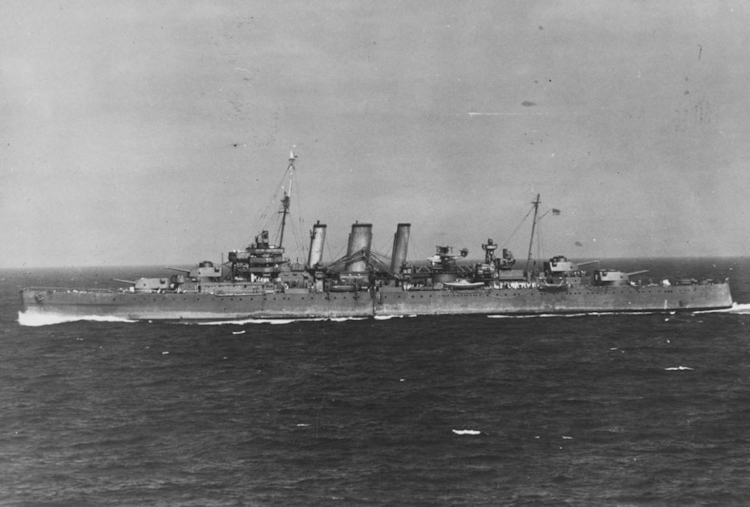
The heavy cruiser HMAS
Australia in late August 1942
For the remainder of the month Australia operated in the
South Pacific and escorted U.S. aircraft-carriers which
fought in the battle of the Eastern Solomons. Farncomb was
awarded the Distinguished Service Order (1942) for his
services in the Solomon Islands. He saw little action in
1943 until December when he directed the ship's bombardment
that supported the landings at Cape Gloucester, New Britain.
Crutchley was less impressed with Farncomb than Crace had
been. In early 1944 the Federal government decided
that Captain (Sir) John Collins would be the first Royal
Australian Navy College trained officer to command the Australian Squadron
and that Farncomb would succeed him. Farncomb left Australia
in March, took short courses in England and was given
command of the escort-carrier, HMS Attacker, in May.
Under Farncomb, Attacker was senior ship of a group of
escort-carriers. On 12 August 1944 she sailed from Malta to
support the invasion of the south of France. Allied troops
landed on the 15th and Attacker's aircraft smashed railways,
roads and bridges to block the enemy's escape. In October
the ship was involved in operations to clear the Germans
from the Aegean Sea and to liberate Greece. Farncomb was
twice mentioned in dispatches for his work in Attacker. His
immediate superior, Rear Admiral (Sir) Thomas Troubridge,
thought highly of him, but observed his 'tendency to fortify
himself with liquor' before important social occasions in
harbour.
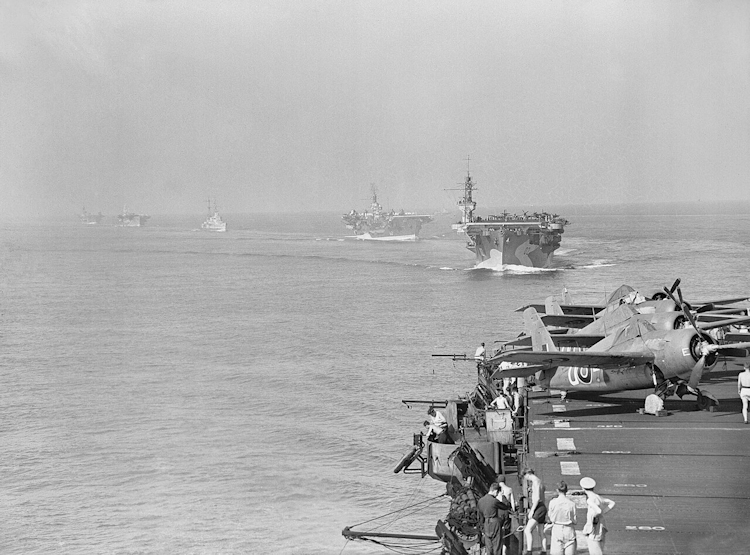
A view of HMS Attacker and
other assault carriers in the naval task force
from HMS Pursuer which took part in the landings in the
south of France.
In October 1944 Collins was wounded in action. Farncomb flew
from the Mediterranean to Manus Island and, on 9 December,
assumed command of the Australian Squadron as Commodore
first class. The invasion of Luzon, Philippines, was
imminent. HMS ships Australia, Shropshire,
Warramunga and
Arunta -- under Farncomb in Australia -- were to be part of Vice
Admiral J. B. Oldendorf's Bombardment and Fire Support Group
of the U.S. Seventh Fleet. Farncomb quickly grasped
'the
voluminous operation orders that emanated from the American
command' and executed them flawlessly.
Off Luzon and in the Lingayen Gulf, between 5 and 9 January
1945 Australia was successively hit by five
kamikaze aircraft. Casualties and damage were severe.
The Five-Day Ordeal (5–9 January 1945)
5 January: While approaching the
gulf, the Australia was struck for the first time in this
operation. A single kamikazi attack caused significant damage and
the casualties were: killed 25 and wounded 30. Yet Farncomb maintained his position in the formation.
6 January: The ship was hit again during
the preliminary bombardment of the landing beaches. This
attack resulted in 14 deaths and 26 wounded.
8 January: Two separate kamikazes attacked
in quick succession.
The first (a twin-engine bomber) skidded across the water
and struck the ship's port side.
The second was shot down just before impact, but its bomb
exploded against the hull, tearing a 14-by-8-foot hole and
causing a 5-degree list.
9 January: A final aircraft struck a mast
strut and the forward exhaust funnel before falling
overboard. This disabled two boilers and damaged the ship's
radar and wireless systems.
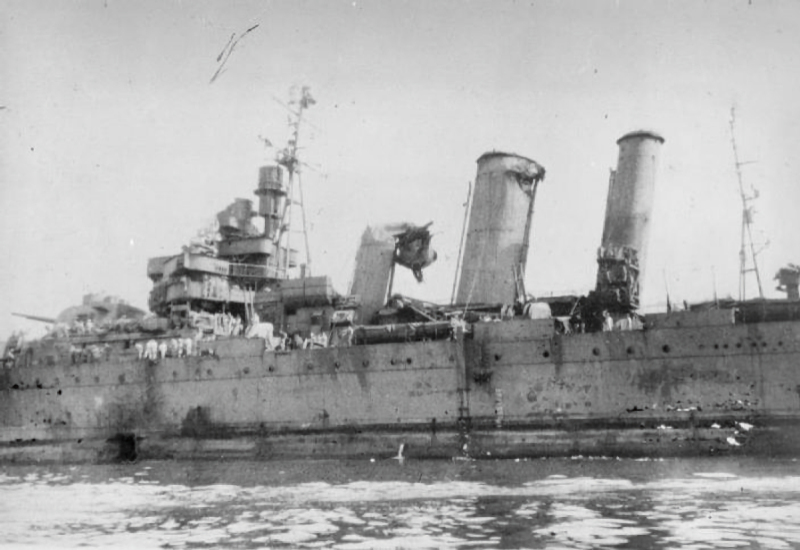
Australia in January
1945 showing accumulated damage from kamikaze attacks
Despite the mounting damage and being personally wounded
during the actions, Farncomb refused to withdraw.
He insisted that Australia complete all its scheduled
fire support missions for the landing troops before finally
being ordered to retire on 9 January.
Vice Admiral Jesse B. Oldendorf (USN) described the ship’s
performance as "inspirational" and noted that Farncomb’s
leadership "imbued his command with confidence". For
his "extraordinary heroism" and "professional skill" during
these five days, the United States awarded him the US Navy
Cross. He was also appointed Companion of the Most
Honourable Order of the Bath (CB) in 1945.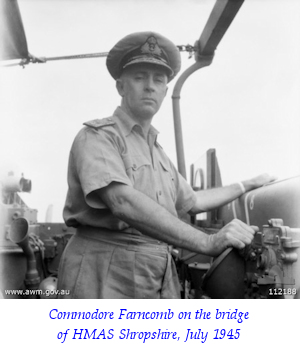
On 22 January he hoisted his broad pendant in
Shropshire and next month witnessed the bombardment and
occupation of Corregidor Island. In May, June and July the
Australian Squadron supported landings at Wewak, New Guinea,
and at Labuan Island and Balikpapan, Borneo. Farncomb was
relieved by Collins on 22 July in Manila and flew to Sydney.
Following a stint (August to September 1945) as Flag
Officer-in-Charge, New South Wales, Farncomb became
Commodore Superintendent of training at Flinders Naval
Depot, Westernport, Victoria. Next year he was appointed
Commander of the U.S. Legion of Merit for his services with
the Seventh Fleet in 1944-45. He went back to sea in
November 1946, initially as Commodore commanding, then as
Flag Officer Commanding HMA Squadron (Fleet). On 8
January 1947 he had been promoted Rear Admiral. He ensured
that the fleet met its commitments in the postwar period
which saw reductions in personnel and ships.
By 1949 Farncomb was frustrated, bored with continual
official entertainment and drinking more than was wise.
Appointed head of the Australian Joint Services Staff in
Washington in January 1950, he seemed unable to curb his
drinking and was recalled in November. He was transferred to
the Retired List of Officers on 7 April 1951.
Vice Admiral
Sir Richard Peek later criticised the Naval Board for...
...the
destruction of Farncomb's career. The burdens and strains of
nearly six years of uninterrupted command at sea and of
increasingly responsible posts in wartime had been severe. The Naval Board could have rested him after the war but
chose not to do so.
Farncomb gave up alcohol completely. He learned Latin to
enable him to study for the Barristers' Admission Board
examinations. Admitted to the Bar on 6 June 1958, he
developed a reasonably busy practice in Sydney and
subsequently joined the solicitors, Alfred Rofe & Sons. As a
lawyer, he showed the same penetrating and analytical mind
and the industry and ability which had characterised his
years in the Navy. Heart disease eventually led to his
retirement.
Honours and Awards
Farncomb received numerous high-level decorations for his
leadership and gallantry including:
|
Awarded on: |
|
Honour |
| 28
March 1935 |
 |
Member of the Royal
Victorian Order (MVO) |
| 03
November 1942 |
 |
Mentioned in
Dispatches (MiD) |
| 09
February 1942 |
 |
Distinguished Service
Order (DSO)
For his skill and resolution
during operations in the Solomon Islands. |
| 23
March 1945 |
|
Mentioned in
Dispatches (MiD)
"For distinguished services & gallantry in
Southern France." |
| 01 May
1945 |
 |
Companion of The Most
Honourable Order of the Bath
(CB, Military
Division)
"For most distinguished services in assault
landing
at Lingayen Gulf." |
| 14
August 1945 |
|
Mentioned in
Dispatches (MiD) |
| 15 May
1947 |
 |
United States Legion
of Merit - Commander (LoM - C) |
| 02
January 1948 |
 |
United States Navy
Cross
"The President of the United States of America
takes pleasure in presenting the Navy Cross to
Commodore Harold Bruce Farncomb, Royal Australian
Navy, for extraordinary heroism and distinguished
service in action as Commander, Royal Australian
Squadron, during the capture of Lingayen Gulf and
the landing on Luzon, Philippine Islands, from 6
January to 9 January, 1945. During this period, in
which HMAS AUSTRALIA was hit four times by enemy
planes and HMAS ARUNTA seriously damaged, Commodore
Farncomb displayed a high degree of courage,
determination and professional skill." |
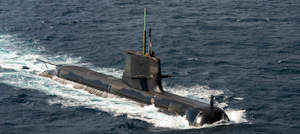
A Collins class submarine was later to be named after him
and in 1998 HMAS Farncomb was commissioned into the Royal
Australian Navy. The motto for HMAS Farncomb,
‘With Skill and Resolve’, is derived from the citation
for the Distinguished Service Order awarded to him as
Commanding Officer HMAS Australia at Guadalcanal in August
1942.
Survived by his wife, Farncomb died on 12
February 1971 in St Vincent's Hospital, Darlinghurst, and
was cremated. His ashes were scattered
at sea from his last flagship, HMAS Sydney.
Admiral Sir Louis Hamilton, Chief of Naval Staff in 1945-48,
had regarded Farncomb as 'the best senior officer' in the
R.A.N., an opinion shared by others. Aloof and reserved,
Farncomb never sought popularity, although the young Trevor
Rapke was one who experienced the charm, humour and 'rich
culture' of the private man. Sailors respected
'Fearless'
for his fair play, justice and courage, and many who served
under him in World War II called themselves 'Farncomb men'.
In conclusion, Vice Admiral Peek commented on Farncomb's
qualities to explain his success as both a ship and
staff officer:
Farncomb's success as a naval officer stemmed from his
willingness to delegate and trust, from the knowledge that
he was very capable and wise and from the fact that the buck
stopped with him. Not that he accepted sloppiness from his
team. On the contrary, he could be savage but accepted blame
from higher authority himself. He was well supported by his
wife Jean. 'Hal' had the best brain (of all the officers known
to me), not only from the point of view of intelligence, but
because of decisiveness.
-o-o-O-o-o- Sources:
U.S. Naval Institute
Australian War Memorial
War History Online
Australian Dictionary of Biography
World War II Database
Anzac Portal
Wikipedia
Compiled by Laurie Pegler |