Commodore Ian Arthur CALLAWAY OAM MiD
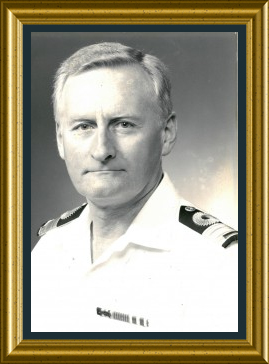 Ian Arthur CALLAWAY was born in Sydney on 21
May 1937, the son of Lieutenant Commander Arthur
Henry Callaway DSO RANVR and Thelma May Callaway
[nee Rowe]. He was educated at Sydney High School
before being selected for the Royal Australian
Navy’s 1953 Intermediate entry. Ian Arthur CALLAWAY was born in Sydney on 21
May 1937, the son of Lieutenant Commander Arthur
Henry Callaway DSO RANVR and Thelma May Callaway
[nee Rowe]. He was educated at Sydney High School
before being selected for the Royal Australian
Navy’s 1953 Intermediate entry.
After graduating from the Naval College in 1955,
Callaway completed training in HMS Triumph, the
Royal Navy’s training ship for officers, before
joining HMAS Melbourne for its maiden voyage to
Australia. He was awarded his Bridge Watch Keeping
Certificate in HMAS Swan in 1957.
He met Beverley Ancher whilst serving as a Recruit
School Divisional Officer in November 1961 and they
were married on 16 June 1962, immediately before
sailing to the United Kingdom for three years.
Callaway was posted to HMS Excellent in the UK and
the long Gunnery Course which commenced in August
1962. On completion of the long Course he served as
the Gunnery Officer in Scarborough whilst on two
years exchange with the Royal Navy. Daughters
Kirsten and Lisa were born in June 1963 and
November 1966.
On return to Australia he was Gunnery Officer, HMAS
Parramatta, towards the end of confrontation with
Indonesia and HMAS Hobart, during her second
deployment to the war in Vietnam. He was Mentioned
in Despatches in 1969 for.....
..... the meritorious
performance of his duties as Gunnery Officer.
It
was during this deployment that Hobart, during a
friendly fire incident, was struck by three Sparrow
missiles fired by a Thailand-based US Air Force
Phantom aircraft. Two sailors were killed and
several wounded.
In Ian's
words.....
It is a pity that the full details of what happened
on board Hobart and in the operational area around
the DMZ on the morning of 17 June 1968, do not seem
to be available. I don’t believe they were
investigated thoroughly at the time and although I
was the ship’s Gunnery Officer, I was never
formally asked to describe the events of that
night, as I saw them.
Political
context
In the context of the political environment of the
Vietnam War, I have always assumed that no formal
inquiry was held and no timely detailed conclusions
about the incident were released, because the RAN
did not want to embarrass the US. But because
the incident was not looked at thoroughly, the full
details of what happened on board and in the area
and the lessons for the RAN and the relevant US
military commands were never discussed, at least
not at the working level.
I don’t know if this can be called a cover-up,
which suggests that the RAN had something to hide.
I don’t believe it did.
I can only fill in a few details of the gun
engagement.
Shock
wave
I was awakened in my cabin by the shock wave that
went through the ship when the first missile
struck. I reached the Ops Room before the
second missile hit and, in addition to feeling the
shock wave, I heard what sounded like tons of glass
smashing against the after Ops Room bulkhead.
Following these attacks, the state of the ship’s
gun and missile systems were as follows:
a. both missile systems were unserviceable, due to major shrapnel
damage to the missile radar aerials and director
room equipment, and
b. the gunfire control system was down due to the loss of gyro
stabilisation and the missile directors.
There was also a previous radar defect.
Mounts 51 (forward gun) and 52 (aft gun) were
operational, but both were showing signs of a
breech problem that was spreading through all 5”/54
fitted gun mounts. This followed recent
re-barrelling in Subic with the latest modified
barrels. Initially there was turmoil on AA
Control as the port after lookout, ORDSEA
Butterworth, had just been killed by missile
warhead shrapnel from the first attack. Other
members of the AA Control crew were in shock. They
had narrowly escaped a similar fate.
I was told later that the AA Control Officer, CPO
Miller (an HMAS Hobart 1 Pacific War veteran, who
had seen such carnage before) quickly got his team
of lookouts back to their duties when he barked,
“This is what you joined up
for; now get back to your job.”
Very soon after, AA Control was able to report that
a swept wing aircraft had overflown the ship and
they continued reporting what they saw and heard.
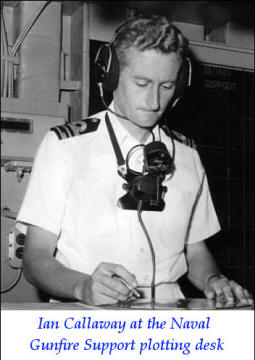
In the Ops Room, I stationed myself at the SPA 50
display at the starboard end of the Evaluator’s
desk. The SPA 50 was displaying an unstabilised SPS
10 picture and on the 20 nautical mile scale an
aircraft could clearly be seen in the vicinity of
the ship. As this aircraft turned towards the ship
from a position about 12 miles out and just to the
right of the rotating ships head marker, I spoke to
the Mount 51 captain, LSEA Stokes, using the ship’s
dial telephone and ordered him to train on 010
relative, elevate to 30 degrees and then to “fire”.
The order meant fire the gun immediately with
whatever ammunition was available in the loader.
The gun mount fired five rounds towards the
approaching aircraft when it was at about four
miles. The aircraft turned away towards the
south without attacking the ship.
Using the same procedure, Mount 51 fired another
five or so rounds towards this aircraft while it
circled threateningly to the south-east.
During this period I heard of reports from USS
Boston and USS Edson that they also were under
attack. Hobart retreated rapidly eastwards by
keeping North Vietnam astern and the aircraft
finally departed the scene.
Miraculous survivors on that night were the members
of the .50 calibre machine gun crew. They
were sitting down next to their weapon on top of
the Ikara magazine and just forward of the first
exploding warhead. Most of the shrapnel
passed over their heads and they suffered
relatively minor injuries.
An important warfare staff posting was as Gunnery
Trials Officer. During this posting, the new M22
gun and M44 Seacat systems in the new construction
ships Swan and Torrens were accepted into service
and the first Australian post refit 5”/54 gun and
Tartar Missile system trials in the DDGs were
carried out. Head Fleet Training Group, OIC Gunnery
School, Navy Office Director Surface and Air
Weapons and Naval Warfare Study Project Officer
followed. The report Callaway produced during this
last posting proposed the introduction of an
Australian Warfare Officers Course and the
establishment of the RAN Surface Warfare School.
This recommendation was implemented.
His sea commands were HMA Ships Anzac [1970-71] and
Stalwart [1979-81]. During the latter period he
accompanied Melbourne during this ship’s last
overseas deployment before paying off in 1982.
He was the Australian student at the National
Defence College, India, in 1984 and he finished his
nearly 40 year naval career with seven years in the
Defence Intelligence Organization, where he reached
the position of Deputy Director Military.
Ian served as President of the Naval Institute from
1986 to 1992. In retirement he was heavily involved
in the community. He was Secretary, then Chairman of
The East Roseville Bowling Club from 1993 until
1999; Secretary of the Cammeray Bridge Club from
1997 until 1999; a member of the Sydney to Canberra
Remembrance Driveway Committee from 1993, and
President from 2000 until forced to stand down from
the presidency in early 2012 due to his ill health.
He was very proud that he and his predecessor Major
General Kevin Latchford AO, with the help of NSW
Roads and Maritime Services finally completed the
development phase of the Remembrance Driveway project and
rescued it from nearly a decade of near inertia.
Ian was also Chair of the Sydney ANZAC Day March
Executive Committee and Chief Marshal of the March
from 2000 until he was forced to stand down in
early 2012. When he stood down from his March
duties, John Haines, RSL State Vice President
[Metropolitan] wrote that.....
..... “With an eye to history
and an understanding toward the motives of those
who wish to honour their relatives, you have
steered the March through some troubled waters and
yet managed to maintain the respect of many who
disagreed with the policies set by the committee
for the benefit of the veterans. That the March is
currently in such a healthy state is in no small
measure due to your stewardship as Chief Marshal”.
Ian was awarded the Medal in the Order of Australia
on 26 January 2013 for .....
..... service to veterans and
veterans’ families.
He was particularly proud of
this award and the successes he had achieved when
advocating the interests of those who served.
Ian Callaway was diagnosed with mesothelioma in
early 2012, and battled the disease for some time. He passed away on
26 September 2013, aged 76.
Sources:
Australian
Naval Institute
Naval Officers Association of Australia
Remembrance Driveway Project
Compiled by Laurie Pegler |